Differentiation in Language Learning and Assessment
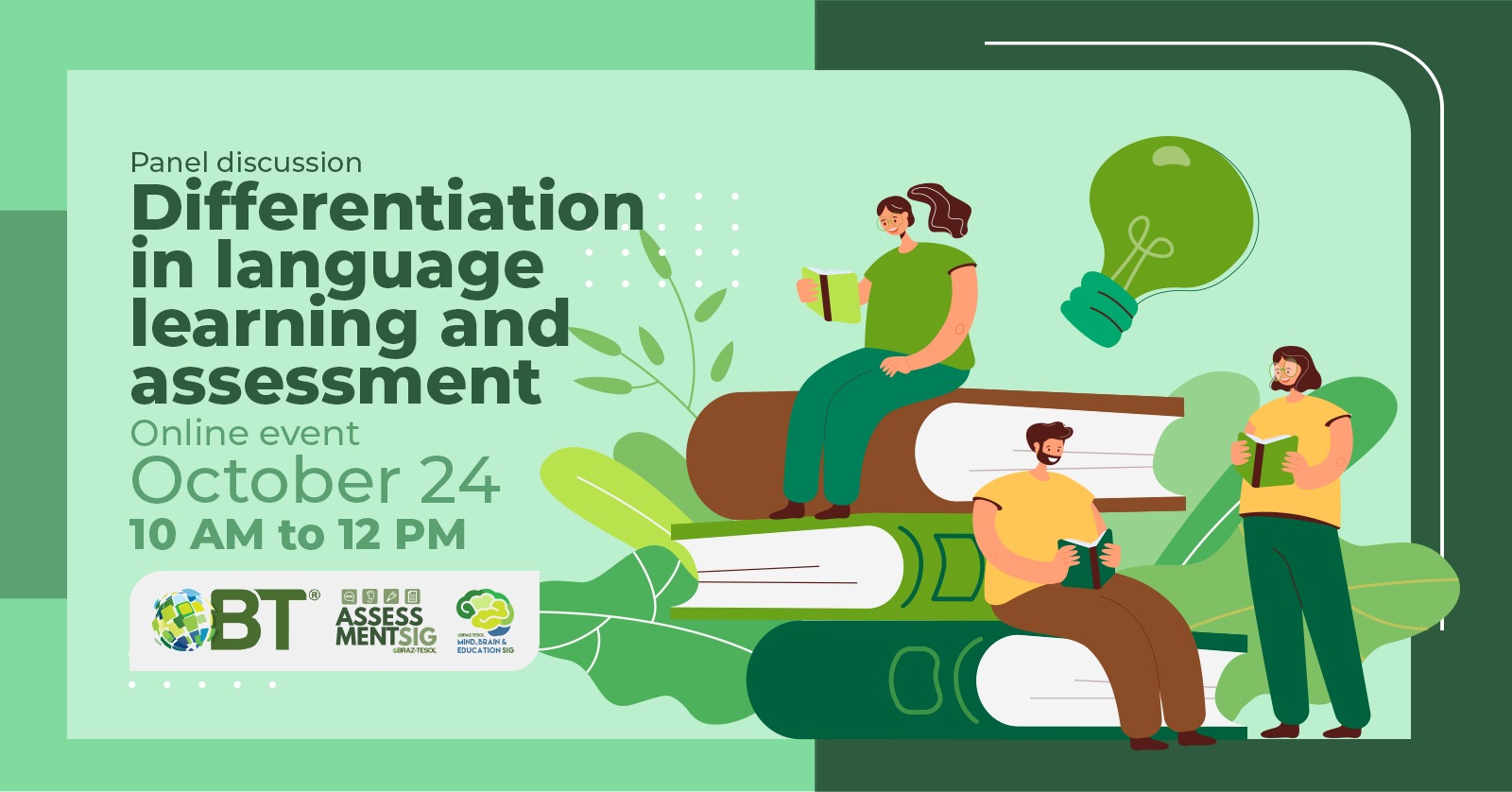
Differentiation in Language Learning and Assessment
How can language assessment respond to learners with different needs, profiles, and ways of learning?
This panel, organized jointly by the BRAZ-TESOL Assessment SIG and the Mind, Brain and Education SIG, brings together three speakers with experience teaching and assessing learners with specific learning needs, including visually impaired learners and learners on the Autism Spectrum.
Through their experiences and perspectives, the speakers will explore challenges, possibilities, and practical approaches to differentiation in language teaching and assessment. The session will also provide a space for participants to discuss ideas, share experiences, ask questions, and consider how assessment practices can become more responsive and inclusive.
Meet the Panelists
Juliana Monteiro has been an English teacher for over two decades and holds an M.Ed. in Education. She currently teaches English Language Arts to high school students at Camino School, a PBL-based school in São Paulo, Brazil. Her professional interests include differentiated instruction and creating different learning pathways so that all students can work towards common classroom goals. Her teaching practice combines Project-Based Learning, Understanding by Design, and a Reading and Writing Workshop approach to ELA. She is particularly interested in using literature to foster meaningful discussions and writing experiences while helping students develop their language skills and become more confident, critical, and independent readers, writers, and thinkers.
Miriam Sester Retorta holds bachelor’s and teaching degrees in English Language and Literature from the Pontifical Catholic University of São Paulo (PUC-SP), an MA in Linguistics from the Federal University of Paraná (UFPR), and a PhD in Applied Linguistics from the University of Campinas (UNICAMP). She also completed postdoctoral research at the State University of Londrina (UEL). Now retired, she has led research and outreach initiatives in English education for visually impaired learners, educational technologies, teacher education, and literacies. Her research interests include assessment literacy, inclusion, digital and mobile literacies, academic-scientific literacy, and multiliteracies.
Sheyla Baumworcel is an educator, educational psychopedagogue, and specialist in Neuroscience Applied to Education, with more than 40 years of classroom experience. She holds a degree in Pedagogy from UCAM and specializations in Educational Psychopedagogy, Neuroscience, Psychomotor Development and Cognition, Autism Spectrum Disorder (ASD), and Learning Disorders. She is the author of books and educational games focused on values, social interaction, and social-emotional skills, as well as an editor and co-author of works on neuroscience and education. She is a postgraduate professor at Faculdade Souza Marques and lectures at conferences, schools, and healthcare institutions throughout Brazil. She currently also teaches Early Childhood Education, connecting theory with everyday classroom practice.
Ready to rethink language assessment? Join the conversation!